
Prepare for A2L Refrigerants with F.W. Webb
A2L refrigerants are transforming the HVAC/R industry. As of January 1st, 2025, HVAC/R professionals like you must handle previously unfamiliar substances.
Questions abound: What additional safety precautions should you take? Do you need to replace your equipment? Will installations change considerably? Why should you get certified?
Background on the Transition
Before answering these questions, it's important to understand the context surrounding the changes. This shift is happening because regulators sought refrigerants with lower Global Warming Potential (GWP). A2L refrigerants have a GWP below 700, meeting requirements of the American Innovation and Manufacturing Act of 2020 and EPA. In the A2L classification, the “A” represents low toxicity, the “2” stands for lower flammability, and the “L” refers to low burning velocity.
Comprehensive Training Resources
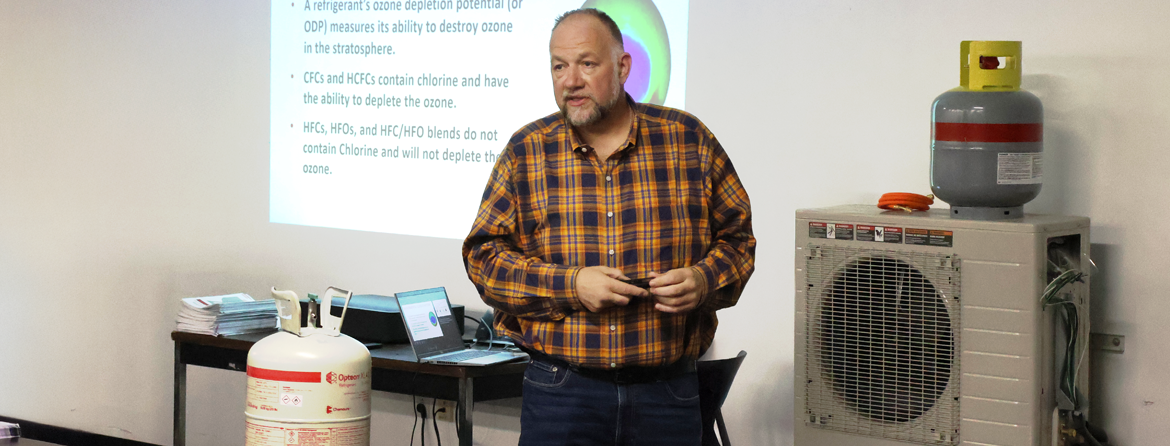
To prepare you for these refrigerants, F.W. Webb offers A2L training classes across its nine-state Northeast territory. Sean Mannion, F.W. Webb's Director of Refrigeration Sales, leads many of the sessions. Since starting in the HVAC/R industry just out of trade school, Sean has witnessed the industry's evolution firsthand over the ensuing years.
Today, he works closely with F.W. Webb's manufacturer partners to bring cutting-edge tools and equipment to the market while sharing his insights with HVAC/R professionals like you.
“I take great pride in our industry and the talent of the people in our industry,” he recently told about 50 technicians who attended his course. “Our work is valuable to our customers, and it's critically important that we leave behind a legacy of excellence, not just for end users, but for the fellow professionals who will maintain our installations in the years to come.”
F.W. Webb's informative training sessions prepare you for the ESCO Institute Low GWP Refrigerant Safety test, which Sean notes is the most widely accepted certification of its kind in the U.S.
Each presentation features 130 slides discussed over about two hours. After completing the class, you take the 50-question test that is scored electronically by ESCO. While the training session is exhaustive, Sean strongly recommends reading ESCO's “Low GWP Refrigerant Safety: Flammable and Mildly Flammable Refrigerants” manual before taking the test.
What You'll Learn
The class provides an in-depth lesson on A2L refrigerants. Here's what to expect:
Focus on Safety
Each class begins with a thorough discussion on refrigerant safety. While A2L refrigerants are mildly flammable and thus slightly different from the refrigerants you've used in the past, standard industry precautions still apply.
“Because you've used proper safety practices, not a lot will change as you begin to work with A2L refrigerants,” Mannion notes.
Before working on A2L-compliant systems, you must conduct pre-project evaluations to identify potential ignition sources. As with all refrigerants, steps must also be taken to mitigate potential toxicity and the risk of asphyxiation. Proper ventilation is needed in case a leak occurs, and a fire extinguisher must be close by.
The extensive safety discussion prepares you on multiple fronts, such as:
- Transportation protocols
- Personal protective equipment guidelines
- Storage and warehousing requirements
- Ventilation reminders
- Jobsite evaluation procedures
Technological Transition
New regulations mean new technology. Mannion reiterates the best practice is using the “right tool for the right job.” When questions arise, consult the owner's manual. In fact, it's important to study manuals for every tool you use.
F.W. Webb's training specifically addresses the equipment and tools used daily, including:
- Gauge manifolds
- Refrigerant hoses
- Vacuum pumps
- Recovery machines
- Recovery tanks
For specific product considerations, Mannion notes that A2L-compliant cylinder tanks lack rupture disks. Instead, these tanks have relief valves with reverse threads, requiring either thread adapters or conversion hoses.
One conversion hose option is the NAVAC 5' Refrigerant Charging Hose without Ball Valve. NAVAC offers a complete line of products that will help you navigate the A2L transition.
At the Jobsite
Despite evolving regulations, the installation processes for A2L and A1 systems share many similarities, and the basic refrigeration cycle with A2L variants remains unchanged. However, it's critical to review the manufacturer's literature and local regulations to maintain compliance and safety.
F.W. Webb's presentation also emphasizes that you must verify all parts and systems are engineered for A2L refrigerants before beginning an installation. The training also covers new labeling requirements for A2L-compatible tanks. Additionally, you'll need to take special care while making system repairs, as equipment needs to be grounded before work starts, among other considerations.
The class also reviews best practices for routine work, such as:
- Charging systems safely
- Recovery equipment and procedures
- Evacuation tips
- Brazing considerations
- Leak testing
- Mitigation strategies
- Piping and pressure testing requirements
Understanding the Refrigerants
What about the composition of A2L refrigerants? Understanding blends, combinations, and reactions becomes critically important when handling these substances under the various conditions you'll encounter as you work.
During the class, you'll explore combustion and thermal decomposition of refrigerants, heat of combustion, and minimum ignition energy.
The session also addresses key information about the composition, measurement, and classification of these gases, with slides discussing:
- Refrigerant blends, including azeotrope and zoetrope
- Fractionation, or the separation of substances
- Refrigeration concentration and lower flammability limits
- Refrigerant designations and classifications
- Refrigerant letter designations
Although many variants exist, three common refrigerant types are discussed in depth: R-454B, R-32, and R-1234YF. As noted in the presentation, R-454B features operating temperatures and pressures comparable to R-410A.
Why Choose F.W. Webb's Training?
Beyond the certification preparation, these interactive classes deliver important benefits to you, your business, and your work, including:
- Regulatory Compliance: Stay ahead of evolving state and local regulations that could eventually match or exceed federal requirements.
- Misconception Clarification: Alleviate any concerns regarding these potentially unfamiliar refrigerants.
- Customer Reassurance: Gain knowledge to authoritatively address end-user questions.
Get Certified
Hundreds of HVAC/R technicians have already embraced these sessions and demand for training continues to grow, with new sessions added regularly.
“Sean does an excellent job with these classes,” says Justin Gelinas, General Manager of F.W. Webb's Hampden, ME branch. “They've been a huge hit and consistently fill our training centers.”
As more A2L-compliant equipment enters the market, now is the time to get certified.
Media Inquiries
Please send an email to
[email protected]